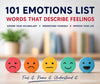
101 Emotions List: Words That Describe Feelings

I created this list of 101 emotions to help people identify and describe what they are feeling beyond common go-to words like happy, angry, sad, and frustrated.
Being able to label feelings is a foundational emotional intelligence skill and crucial to understanding yourself and the people around you. It helps you process emotional pain. And it does something else that I don't think people talk about enough: it helps boost happiness.
Expanding your emotion vocabulary has the potential of improving many parts of your personal and work life. And it's pretty easy to pick up given the right tools.
Below you'll find both a feel-good emotions chart and an uncomfortable emotions chart to help expand your understanding of feelings and emotional experiences.
What's in This Post
- Why Emotion Vocabulary Matters
- How Labeling Emotions Improves Emotional Intelligence
- The Famous Four Emotions
- My Emotion Categories: Beyond Positive and Negative
- 51 Comfortable or Feel-Good Emotions Chart
- 51 Uncomfortable or Painful Emotions Chart
- How Emotions Improve Emotional Intelligence
- How to Use an Emotions Word List
- Emotional Intelligence Resources
Why Emotion Vocabulary Matters
Emotions are information.
They are like your own personal radar system, going out and bringing back pings of information. The better you are at labeling your emotions and processing the information they have to offer, the better your life is.
How Labeling Emotions Improves Emotional Intelligence
Emotional intelligence is the ability to recognize, understand, use, and manage emotions effectively.
A larger emotion vocabulary helps you:
- Understand yourself better
- Communicate more clearly
- Savor happiness
- Understand what brings you joy
- Improve relationships
- Reduce misunderstandings
- Solve problems more effectively
- Recognize emotional triggers
- Regulate your emotions
- Overreact less
- Feel less stressed
- Respond rather than react
- Develop greater empathy for others
People with stronger emotional intelligence are often happier, and better equipped to navigate challenges, resolve conflicts, and maintain healthier relationships. And it is a prized skill set for work settings of all kinds.
The Famous Four Emotions

When it comes to emotions, people tend to be taught what I call The Famous Four: mad, glad, sad, and afraid.
There are thousands of emotion words in the English language. Only knowing four is very limiting. It creates an emotional handicap that gets in the way of understanding what’s going on for yourself and for others.
For example, a person might say they're mad when they're actually feeling any emotional discomfort, such as:
- Rejected
- Embarrassed
- Powerless
- Disrespected
- Hurt
- Overwhelmed
Likewise, someone who says they're happy (glad) might actually be feeling any feel-good emotion, such as:
- Grateful
- Proud
- Encouraged
- Connected
- Hopeful
- Inspired
The more specific you can be, the more useful the information becomes.
My Emotion Categories: Beyond Positive and Negative
Before we go further, I should explain my labels for categories of emotions.
I struggled for years to figure out how to avoid the pitfalls of calling emotions positive and negative. When we label emotions positive and negative, we can mistakenly conclude:
positive emotions = good emotions
and
negative emotions = bad emotions
And our mind can take further leaps: “I would be bad if I had bad emotions; therefore, don’t have them,” or “You’re bad because you have bad emotions.” The philosophy that some emotions are bad is a dangerous mindset.
Emotions exist to help us make wise decisions. Denying half of our emotional experience thwarts that feedback system and gets in the way of health and happiness. It also contributes to us storing those emotions. People may have the false impression that they are in control of their emotions when they act as if they don’t feel any emotional discomfort. In reality, we are the most in control of our emotions when we deal with them head-on.
After much thought, I came up with labeling emotion categories according to their general feeling: comfortable or feel-good and uncomfortable or painful, instead of positive and negative.
51 Comfortable or Feel-Good Emotions Chart
The information in feel-good emotions includes:
- what provided happiness,
- whether the source of the happiness is good for you, and
- why you are drawn to certain things.
Discovering healthy sources of happiness can lead you to figure out how to get more of that in your life.
Recognizing which of your happiness sources are unhealthy can lead you to figure out what pulls you toward that source and how to make changes to free you from that draw.
I've provided the feel-good emotions in both text list and graphic chart formats so you can use whichever reference works best for you.
|
Accepted |
Important |
Note:
- Surprised is an example of an emotion that is sometimes comfortable and sometimes uncomfortable.

51 Uncomfortable or Painful Emotions Chart
Emotional discomfort gets your attention and helps you stay safe. Labeling the emotion provides critical information and direction.
But--the system doesn't always work as intended because we sometimes overreact and have more emotional pain than fits the situation. In these instances, identifying the emotion provides a first step to sorting that out.
A note about anger: Anger is a secondary emotion.
Anger begs the question, “What emotional discomfort isn’t getting dealt with directly and is getting turned into anger?” Or another way to put it: “What’s underneath this anger?”
Any uncomfortable emotion, or many uncomfortable emotions, could be under an instance of feeling irritated, annoyed, or higher levels of anger.
🟢➜ I explain more in this post: Anger Is a Secondary Emotion: Tip of the Iceberg
I've provided the feel-good emotions in both text list and graphic chart formats so you can use whichever reference works best for you.
|
Abandoned |
Inadequate |
Notes:
- * Surprised is an example of an emotion that is sometimes comfortable and sometimes uncomfortable.
- ** Angry is a secondary emotion: some other uncomfortable emotion(s) is/are under the anger.

How to Use the Emotions Word Lists
Here are just a few ways the emotion list can be used.
Understanding Yourself
Use the emotion lists to identify what you are feeling beyond your usual go-tos.
You can then think about what information that emotion is telling you about your experience.
Bonus: Once you have identified what an emotion feels like, you are more likely to recognize it the next time it pops up.
Communication
Instead of saying "I'm upset," try identifying the specific feeling and communicating that. The person you are talking to will have better information for understanding your perspective.
Parenting
Children often benefit from learning a wider range of feeling words so they can better understand and express themselves.
Counseling and Coaching
Emotion vocabulary lists can help clients identify and discuss emotions more accurately.
Social Emotional Learning (SEL)
Emotion vocabulary is a foundational skill for developing emotional awareness, self-management, empathy, and relationship skills.
Emotional Intelligence Resources

I use the 101 Emotions List throughout all of the many emotional intelligence resources I've created.
These include:
- Silver Lining series of workbooks and journals with writing prompts, including: Becoming Calm Anxiety Workbook and Journal, Increasing My Happiness Quotient Journal, and Building Skills to Uplevel Life Emotional Intelligence Workbook
- Emotional Intelligence Booster card set
-
SEL workbooks and activities
Developing emotional intelligence starts with recognizing feelings, naming them, and learning how to use the information they provide.
The more emotion words you know, the more clearly you can understand yourself and communicate with others.
- Ann Silvers





Comments 0